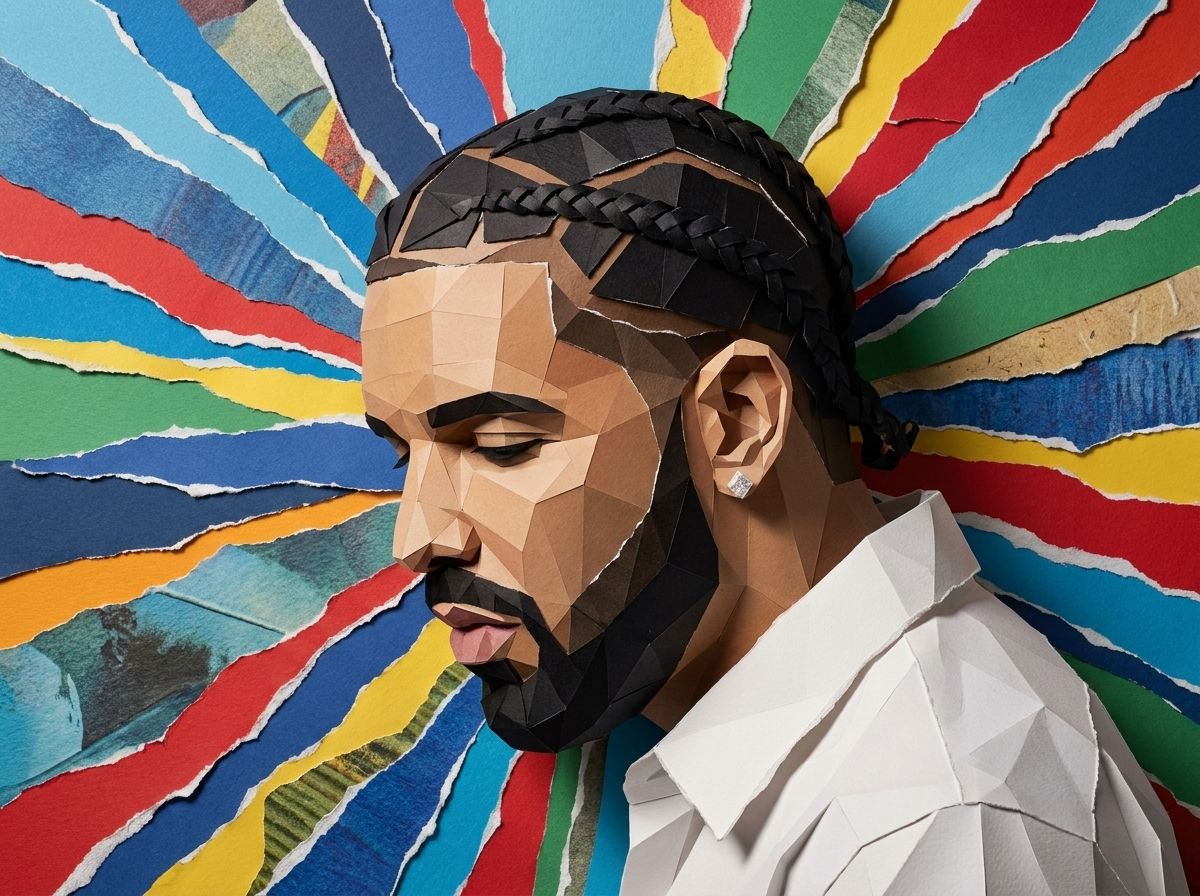
Inside Drake’s Multi-Million Dollar Legal and Corporate War with UMG
The music industry is witnessing an unprecedented convergence of legal warfare and corporate governance failure. What began as a lyrical rap battle between top artists Drake and Kendrick Lamar has metastasized into a volatile institutional conflict, one that now implicates the executive leadership of Universal Music Group, the world’s largest music corporation, and raises uncomfortable questions about how streaming platforms and major labels exercise coordinated market power.
This is an inside look at how Drake’s battle shifted from the recording booth to the boardroom, who sits in his crosshairs, and the calculated exit strategy he is executing in plain sight.
The Corporate Targets: Grainge and Janick
Drake’s grievance is not principally with a rival artist. It is with the corporate infrastructure that amplifies, distributes, and monetizes that rival’s output, and with the executives he believes directed that infrastructure against him.
Through his legal entity, Frozen Moments LLC, Drake launched proceedings targeting UMG’s most senior leadership, alleging the label actively weaponized its institutional resources to damage his brand and enrich itself in the process.
Sir Lucian Grainge — Chairman & CEO, Universal Music Group
As the most consequential executive in the recorded music business, Sir Lucian Grainge has spent two decades building UMG into a corporation that controls roughly a third of all recorded music revenue globally. His relationship with Drake was, for years, one of the label’s most profitable partnerships.
That relationship has now completely fractured.
Drake’s legal team sought to compel Grainge into court depositions, alleging he personally approved a corporate strategy to amplify Kendrick Lamar’s diss campaign in order to maximize engagement and streaming revenues across UMG’s catalog and platform relationships. Grainge’s legal team dismissed the claims as “farcical” and accused Drake of weaponizing the discovery process to harass label leadership.
The feud crossed into personal territory when Drake posted modeling photographs of Grainge’s daughter-in-law, Sofia Richie, on social media, a signal that professional norms between the two parties have entirely collapsed.
John Janick — CEO, Interscope Geffen A&M
Because Kendrick Lamar’s music flows through Interscope, one of UMG’s flagship imprints, Janick became a central figure in Drake’s discovery requests. Drake’s legal team demanded access to Janick’s executive compensation structure and corporate bonus arrangements, seeking to establish that Interscope leadership held direct financial incentives tied to the commercial performance of Lamar’s anti-Drake material. The implication: that label executives were not passive distributors, but active beneficiaries with skin in the game.
Why the Case Stalled: The Defamation Threshold
The legal campaign encountered a fundamental obstacle when a federal judge dismissed Drake’s initial defamation petition. The court’s reasoning was rooted in the cultural architecture of hip-hop itself.
The judge ruled that the contested lyrics in Kendrick Lamar’s “Not Like Us” constituted nonactionable opinion, the legal standard that separates protected expression from actionable falsehood. Under that standard, a reasonable listener encountering a rap diss track does not receive it as a statement of literal, verifiable fact. The genre operates on hyperbole, competitive provocation, and artistic aggression. Because the statements could not be tested for objective falsity in the way that factual claims can be, the defamation theory lacked the necessary foundation.
The dismissal did not resolve the underlying corporate conduct claims, but it removed Drake’s most direct instrument of reputational recourse against Lamar’s catalog.
The Streaming Conspiracy: Algorithmic Power and Platform Economics
Despite the legal setback, Drake’s filings surfaced a more structurally significant set of allegations, ones that, regardless of their ultimate legal merit, illuminate how concentrated the music industry’s technological infrastructure has become.
Drake accused UMG and Interscope of coordinating with major streaming platforms, most notably Spotify, to distort organic market outcomes in Lamar’s favor.
The specific allegations: that UMG deployed bot farms to artificially inflate “Not Like Us” streams, repeat plays, and algorithmic signals; that the label used financial arrangements disguised as promotional partnerships to secure preferential playlist placement, a modern iteration of the payola schemes that regulators dismantled in terrestrial radio decades ago; and that UMG’s licensing agreements with DSPs included provisions that suppressed Drake’s catalog visibility in exchange for favorable terms on other releases.
These claims matter beyond the immediate dispute because they describe a real structural tension in streaming economics. Spotify’s recommendation engine, built on a combination of collaborative filtering, audio analysis, and behavioral signals, is deeply susceptible to early momentum. A track that accumulates streams rapidly in its first 48 to 72 hours receives algorithmic amplification that compounds its advantage. Labels with the resources and platform relationships to manufacture that early velocity hold an asymmetric advantage over independent releases and even over artists at competing labels.
Whether Drake’s specific allegations are legally provable is a separate question from whether the underlying dynamic he is describing is real. It is. The major labels, UMG in particular, have invested heavily in data infrastructure through relationships with analytics firms like Luminate, which monitors streaming performance in near real-time and allows label teams to make promotional decisions with a precision that independent artists cannot match. The line between sophisticated marketing and market manipulation is one the industry has never been required to draw clearly.
The Exit Strategy: Album Delivery as a Corporate Weapon
With the defamation case stalled and his relationship with Grainge irreparably damaged, Drake executed a move that reveals how thoroughly he understands the contractual mechanics of his own situation.
He released a massive triple-album project comprising Iceman, Habibti, and Maid of Honour, totaling 43 tracks and flooding the Billboard charts simultaneously.
Industry observers were quick to identify this not as a conventional creative rollout but as a contractual liquidation event. Major label recording agreements in the streaming era are typically structured around album delivery obligations, a set number of project commitments an artist must fulfill before the contract expires or renewal terms trigger. By releasing 43 tracks across three projects in a compressed window, Drake is methodically burning through his remaining obligations at a pace UMG cannot commercially absorb or strategically counter.
The play is precise. Once those delivery obligations are satisfied, Drake will exit UMG with ownership of his future masters intact, a position that, for an artist of his catalog value, represents hundreds of millions of dollars in long-term asset value. The legal battles, by this reading, were never primarily about winning in court. They were about creating enough institutional friction to justify the exit and document the grievance publicly while he executed the commercial escape.
A Pattern Emerges: The Dreamville Exit
Drake’s departure strategy did not unfold in isolation. Around the same time his legal campaign against UMG was generating headlines, a quieter but equally telling exit was taking shape at Interscope’s own doorstep.
In July 2025, Dreamville Records ended its distribution deal with Interscope Records, the UMG subsidiary that had served as the label’s institutional home. J. Cole and his co-founder Ibrahim “Ib” Hamad did not make the split a public spectacle. There were no lawsuits, no social media salvos, no depositions. But the outcome was the same: a deliberate, negotiated exit from the UMG ecosystem.
What followed revealed the terms of departure were notably favorable. Rumors of an outright sale circulated after Dreamville artists JID and Bas publicly discussed receiving substantial payouts when the deal ended, with Cole distributing proceeds among the entire roster. Hamad moved quickly to correct the record. He confirmed that Dreamville had not been sold and remained fully independent, clarifying that the financial windfall came from the closure of the partnership itself, not a buyout.
The details that emerged from the roster were striking in their specificity. Dreamville artist Cozz noted that beyond the financial distribution, Cole ensured that artists walked away owning the majority of their masters, a concession that UMG-affiliated deals rarely produce voluntarily. JID framed Cole’s handling of the transition as one of the most genuinely selfless acts in recent hip-hop history, noting that Dreamville artists who were part of the deal could walk away from music entirely and remain financially secure.
The significance here is institutional, not sentimental. Dreamville was distributed through Interscope, the same UMG imprint that sits at the center of Drake’s legal claims against John Janick. Cole and Hamad watched that imprint become a focal point in one of the most contentious corporate disputes in the industry’s recent history. They observed how UMG’s handling of the Drake-Lamar conflict exposed the internal mechanics of how the label system allocates promotional resources and financial incentives across its roster. And then they quietly negotiated their way out.
The contrast in style between the two exits is instructive. Drake chose maximum institutional pressure: litigation, public grievance, and a deliberate flood of contractual deliverables designed to force the issue. Cole chose strategic patience and confidential negotiation, arriving at independence without scorched earth. Both arrived at the same destination.
What the Dreamville exit confirms is that the Drake situation was not an isolated talent relations failure. It was symptomatic of a broader erosion of trust between UMG’s executive leadership and the independent-minded imprints that had built their identities around artist ownership and long-term autonomy. When the industry’s most visible conflict made UMG’s internal incentive structures a matter of public legal record, labels with the leverage to leave began making their calculations. Dreamville simply made theirs without announcing it.

The Institutional Lesson
The deeper lesson here is about the governance risk that comes with asymmetric dependence. UMG possesses unmatched infrastructure, including distribution networks, streaming relationships, data analytics, promotional machinery, and legal resources. What it demonstrated in this episode is that raw infrastructure advantage cannot substitute for the relational stewardship of a small number of extraordinarily high-value artists.
Drake represented a disproportionate share of UMG’s streaming revenue and cultural cachet. When the label’s commercial incentives around a rival’s catalog were perceived, rightly or wrongly, as being prioritized over his protection, the relationship became untenable. The artist then used every contractual and legal instrument available to him to engineer an exit, making the disengagement as costly, visible, and damaging to the label’s reputation as possible.
In an industry now governed by algorithmic platforms and real-time data, the next iteration of this conflict will likely be even more technically sophisticated. The artists who understand their contractual architecture, their streaming economics, and the mechanics of platform distribution as well as their lawyers do are the ones who will dictate the terms of their own futures, not the labels that thought they held all the leverage.
Leave a Reply
You must be logged in to post a comment.