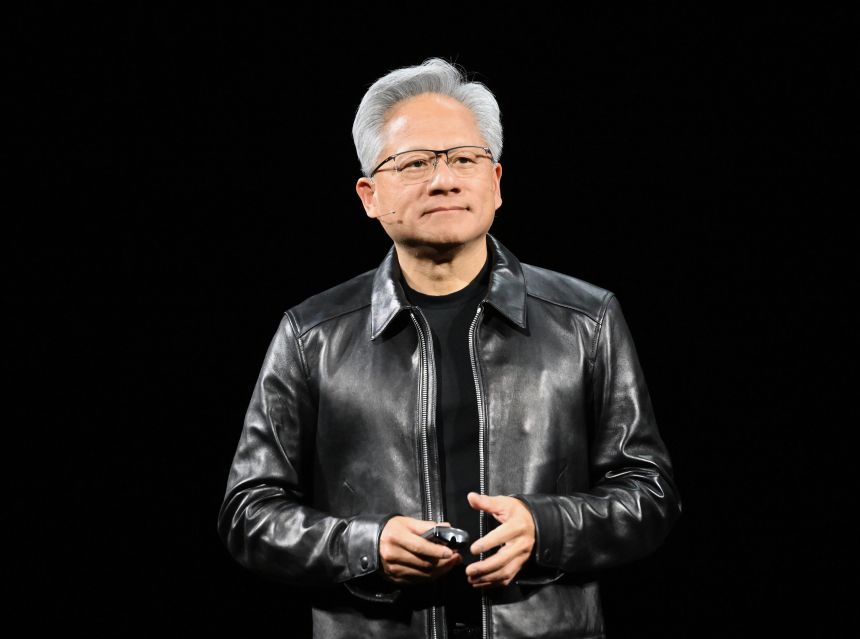
Major development, and a predictable outcome. Once the allegations surfaced, a leadership change was a question of when, not whether. Nvidia’s board announced on November 12 that Jensen Huang resigned as president, CEO and director effective immediately, after 33 years, with no permanent successor named and Q3 earnings only days away. The reported trigger was allegations of extramarital affairs, including one involving a woman suspected of spying for China. That makes this a governance and national-security shock more than a strategic one, and for an industry whose AI buildout runs largely on Nvidia silicon and CUDA, the founder’s exit removes the single most influential product and ecosystem voice at the center of the sector.
Shares fell 13.4% after the open before a slight correction, so expect the market to price in execution, customer-confidence and export-control scrutiny risk across the supply chain, from TSMC and SK Hynix to hyperscaler customers and rivals like AMD and Arm-based custom silicon. Nvidia’s stated message is continuity: the board expects operations, customer commitments and the product roadmap to continue without interruption. On succession, CFO Colette Kress is interim CEO while keeping the CFO role, and the search is open to internal and external candidates, with no timetable and no search firm named.
Analysts have most often named engineer Ian Buck as the leading permanent candidate, with Kress second. One analyst suggested a possible co-CEO structure pairing Kress with Buck, and Arm CEO Rene Haas, a former Nvidia executive, was floated as an external option. Rather than “erecting” an obscure board member, the board appointed Harvey C. Jones, former CEO and executive chairman of Synopsys, as its first-ever Chair. He is 73 and has been an Nvidia director since 1993, so he is a veteran insider rather than an outside reformer. Next, watch the Q3 earnings call and guidance for any hit to customer commitments; the timing and profile of the permanent CEO pick (insider continuity versus an outside operator); whether the board’s own investigation findings are disclosed, given that commentators have already questioned why the release skipped the board’s probe; any U.S. government or congressional scrutiny of the China-linked allegations and what that means for export-control posture; and whether key executives, customers or hyperscaler partners signal any change in their commitments.
Leave a Reply
You must be logged in to post a comment.